Question 1 of 10
On a topographic map, contour lines that are spaced very close together indicate:
Aa body of water
Bperfectly flat land
Ca gentle slope
Da steep slope
Explanation
Closely spaced contour lines mean elevation changes rapidly over a short distance — a steep slope.
Question 2 of 10
A barometer is an instrument used to measure:
Aair temperature
Bwind speed
Crelative humidity
Dair pressure
Explanation
A barometer measures atmospheric (air) pressure.
Question 3 of 10
As the temperature of air increases, the maximum amount of water vapor the air can hold:
Astays the same
Bincreases
Cdrops to zero
Ddecreases
Explanation
Warmer air can hold more water vapor before becoming saturated.
Question 4 of 10
About how long does it take Earth to ROTATE once on its axis?
A12 hours
Babout one month
C365 days
D24 hours
Explanation
One rotation of Earth on its axis takes about 24 hours, producing day and night.
Question 5 of 10
As altitude increases within the lower atmosphere, air pressure generally:
Adoubles
Bstays constant
Cdecreases
Dincreases
Explanation
There is less air above you at higher altitudes, so air pressure decreases.
Question 6 of 10
The apparent daily motion of the Sun across the sky (rising in the east and setting in the west) is caused by:
Athe gravitational pull of the Moon
BEarth's rotation on its axis
CEarth's revolution around the Sun
Dthe Sun orbiting Earth
Explanation
Earth rotates west-to-east on its axis, making the Sun appear to move east-to-west each day.
Question 7 of 10
The topographic map shows four locations labeled A, B, C, and D. At which location is the land surface STEEPEST? 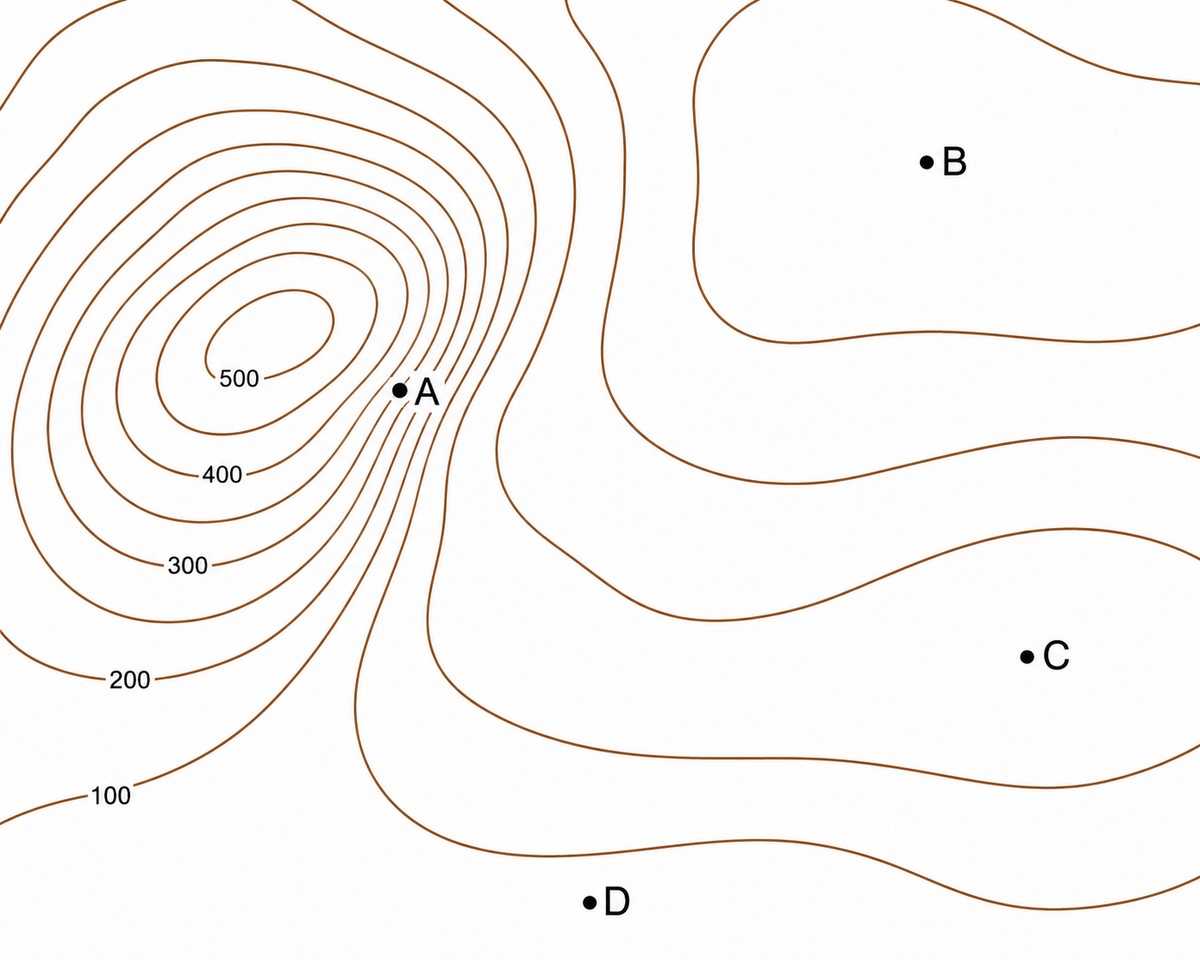
AA
BD
CB
DC
Explanation
Contour lines bunched close together show a steep slope (large elevation change over a short horizontal distance). They are closest at point A.
Question 8 of 10
Approximately how long does one complete revolution of Earth around the Sun take?
A27.3 days
B365¼ days (one year)
C24 hours
D30 days
Explanation
One revolution (orbit) of Earth around the Sun takes about 365¼ days — one year.
Question 9 of 10
The shape of the orbits of the planets around the Sun is best described as:
Aa square
Ban ellipse
Ca perfect circle
Da straight line
Explanation
Planetary orbits are ellipses (slightly elongated circles), with the Sun at one focus.
Question 10 of 10
Using the labeled contour lines on the map, what is the contour interval? 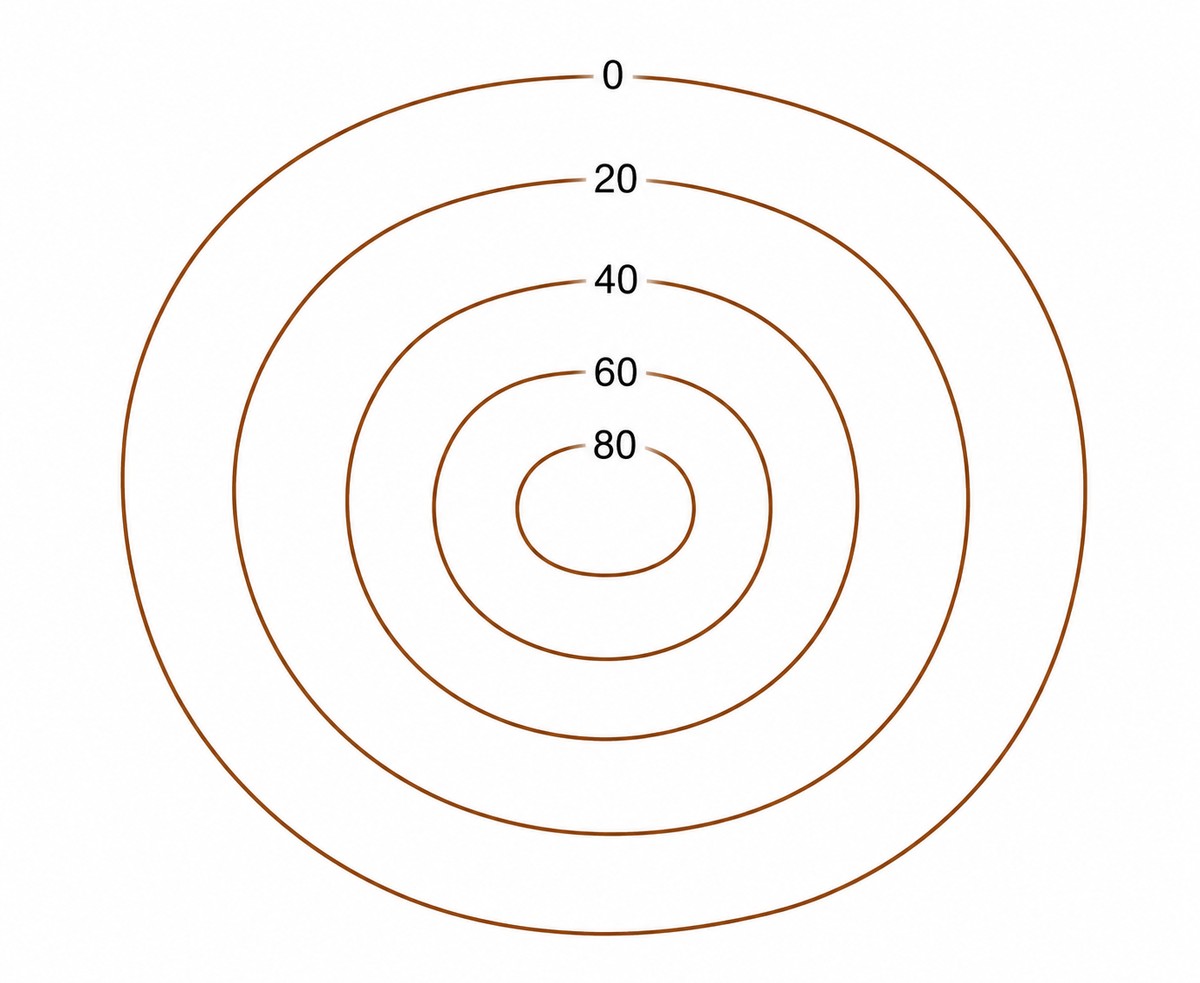
A20 feet
B40 feet
C80 feet
D10 feet
Explanation
The contour interval is the elevation change between adjacent lines: 20 − 0 = 20.